RESEARCH PAPER
RESEARCH PAPER
RESEARCH PAPER
Creating Focused Environments: The Role of Continuous Music and Light in ADHD Management
Creating Focused Environments: The Role of Continuous Music and Light in ADHD Management
Creating Focused Environments: The Role of Continuous Music and Light in ADHD Management
Internship at the Indian Institute of Science, mentored by Dr. Tarun Kumar
Internship at the Indian Institute of Science, mentored by Dr. Tarun Kumar
Internship at the Indian Institute of Science, mentored by Dr. Tarun Kumar
Abstract
Attention Deficit Hyperactivity Disorder (ADHD), a neurodevelop- mental disorder predominantly seen in children, also affects over 2.6% of adults in the world. Adults with this disorder have often faced a series of challenges affecting their daily lives, including difficulties with time management, focus, attention, and emotional regulation. This study proposes a customizable and com- prehensive application to address these issues. The Music Emotion Recognition Model, built on InceptionV3, achieved an accuracy of 75.99%, effectively cate- gorizing music tracks into two distinct emotion types – high arousal and low arousal, and creating infinite audio loops, with the aim of providing stimulation to the ADHD brain, eliminating distractions and improving focus on a cognitive task. The app also integrates adaptable smart lighting to create a focus-friendly environment, with repeated exposure aimed at enhancing cognitive performance. This innovative approach offers a potential management solution for adults with ADHD to help manage inattention symptoms, though its effectiveness is yet to be tested.
Abstract
Attention Deficit Hyperactivity Disorder (ADHD), a neurodevelop- mental disorder predominantly seen in children, also affects over 2.6% of adults in the world. Adults with this disorder have often faced a series of challenges affecting their daily lives, including difficulties with time management, focus, attention, and emotional regulation. This study proposes a customizable and com- prehensive application to address these issues. The Music Emotion Recognition Model, built on InceptionV3, achieved an accuracy of 75.99%, effectively cate- gorizing music tracks into two distinct emotion types – high arousal and low arousal, and creating infinite audio loops, with the aim of providing stimulation to the ADHD brain, eliminating distractions and improving focus on a cognitive task. The app also integrates adaptable smart lighting to create a focus-friendly environment, with repeated exposure aimed at enhancing cognitive performance. This innovative approach offers a potential management solution for adults with ADHD to help manage inattention symptoms, though its effectiveness is yet to be tested.
Abstract
Attention Deficit Hyperactivity Disorder (ADHD), a neurodevelop- mental disorder predominantly seen in children, also affects over 2.6% of adults in the world. Adults with this disorder have often faced a series of challenges affecting their daily lives, including difficulties with time management, focus, attention, and emotional regulation. This study proposes a customizable and com- prehensive application to address these issues. The Music Emotion Recognition Model, built on InceptionV3, achieved an accuracy of 75.99%, effectively cate- gorizing music tracks into two distinct emotion types – high arousal and low arousal, and creating infinite audio loops, with the aim of providing stimulation to the ADHD brain, eliminating distractions and improving focus on a cognitive task. The app also integrates adaptable smart lighting to create a focus-friendly environment, with repeated exposure aimed at enhancing cognitive performance. This innovative approach offers a potential management solution for adults with ADHD to help manage inattention symptoms, though its effectiveness is yet to be tested.
Roles and Responsibilities
Design Research
Data Analyst
UX Designer
AI Developer
Roles and Responsibilities
Design Research
Data Analyst
UX Designer
AI Developer
Roles and Responsibilities
Design Research
Data Analyst
UX Designer
AI Developer
Tools used
Google Scholar
Figma
Notion
Google Colab Notebook
Tools used
Google Scholar
Figma
Notion
Google Colab Notebook
Tools used
Google Scholar
Figma
Notion
Google Colab Notebook
Project Context
Design Research Internship
@ Indian Institute of Science
Under mentorship of Dr. Tarun Kumar
June - Nov 2024
Project Context
Design Research Internship
@ Indian Institute of Science
Under mentorship of Dr. Tarun Kumar
June - Nov 2024
Project Context
Design Research Internship
@ Indian Institute of Science
Under mentorship of Dr. Tarun Kumar
June - Nov 2024
Research Outcome
Accepted at ICBTOxford’24
Presented on 21st November 2024
To be Published in the esteemed Springer Lecture Notes in Network and Systems (LNNS) series
Research Outcome
Accepted at ICBTOxford’24
Presented on 21st November 2024
To be Published in the esteemed Springer Lecture Notes in Network and Systems (LNNS) series
Research Outcome
Accepted at ICBTOxford’24
Presented on 21st November 2024
To be Published in the esteemed Springer Lecture Notes in Network and Systems (LNNS) series
Defining the Problem
Adults with ADHD:
Adults are often diagnosed in children, but has a persistence rate of 50-65%, affecting individuals well into adulthood.
Inattentive Subtype:
Over 90% of adults with ADHD experience its inattentive subtype, which is characterized by procrastination, sluggish cognitive tempo, inability to sustain long-term attention on cognitive tasks and problems with time management and memory.
Existing Solutions:
Current treatments lack personalized interventions, and focus on individual symptoms
Defining the Problem
Adults with ADHD:
Adults are often diagnosed in children, but has a persistence rate of 50-65%, affecting individuals well into adulthood.
Inattentive Subtype:
Over 90% of adults with ADHD experience its inattentive subtype, which is characterized by procrastination, sluggish cognitive tempo, inability to sustain long-term attention on cognitive tasks and problems with time management and memory.
Existing Solutions:
Current treatments lack personalized interventions, and focus on individual symptoms
Defining the Problem
Adults with ADHD:
Adults are often diagnosed in children, but has a persistence rate of 50-65%, affecting individuals well into adulthood.
Inattentive Subtype:
Over 90% of adults with ADHD experience its inattentive subtype, which is characterized by procrastination, sluggish cognitive tempo, inability to sustain long-term attention on cognitive tasks and problems with time management and memory.
Existing Solutions:
Current treatments lack personalized interventions, and focus on individual symptoms
Research Focus
Music and Focus:
Studies show that non-lyrical, rhythmic music helps regulate emotions and improve focus in individuals with ADHD. Personalized music preferences further enhance attention by creating a positive emotional connection, reducing distractions, and promoting sustained cognitive engagement.
Lighting and Focus:
Research suggests that customizable lighting, particularly bright white and blue-enriched light, boosts attention and reduces cognitive fatigue. By adjusting lighting to suit individual needs, users can optimize their environment for better focus and productivity.
Research Focus
Music and Focus:
Studies show that non-lyrical, rhythmic music helps regulate emotions and improve focus in individuals with ADHD. Personalized music preferences further enhance attention by creating a positive emotional connection, reducing distractions, and promoting sustained cognitive engagement.
Lighting and Focus:
Research suggests that customizable lighting, particularly bright white and blue-enriched light, boosts attention and reduces cognitive fatigue. By adjusting lighting to suit individual needs, users can optimize their environment for better focus and productivity.
Research Focus
Music and Focus:
Studies show that non-lyrical, rhythmic music helps regulate emotions and improve focus in individuals with ADHD. Personalized music preferences further enhance attention by creating a positive emotional connection, reducing distractions, and promoting sustained cognitive engagement.
Lighting and Focus:
Research suggests that customizable lighting, particularly bright white and blue-enriched light, boosts attention and reduces cognitive fatigue. By adjusting lighting to suit individual needs, users can optimize their environment for better focus and productivity.
Methodology and Approach
Identifying User Needs:
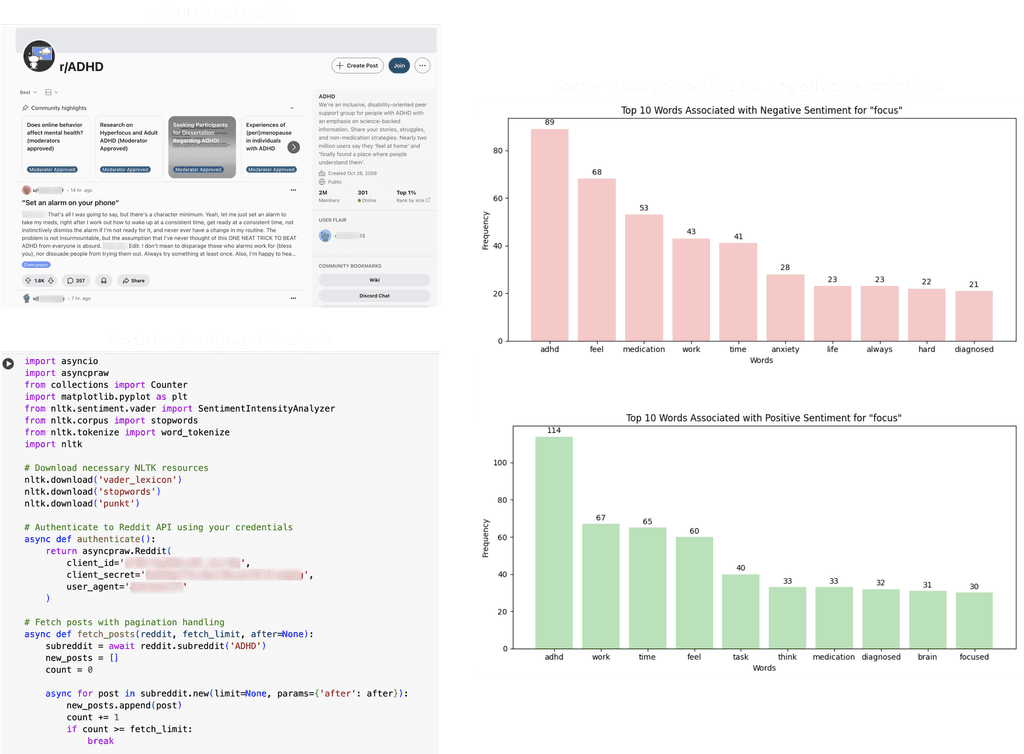
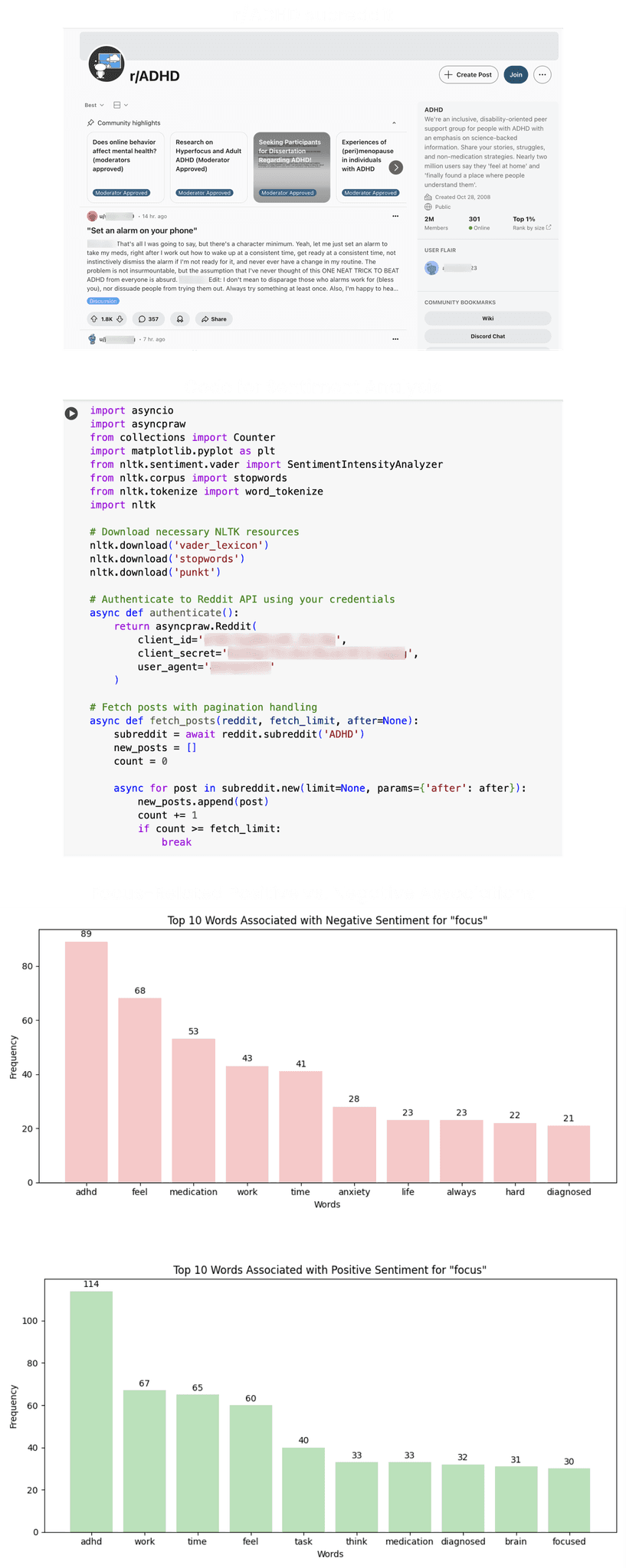
To analyze challenges faced by adults with ADHD, sentiment analysis was conducted on discussions from the r/ADHD subreddit. 1000 posts were retrieved at a time and sentiment analysis was performed using VADER, which classified the posts into positive and negative sentiments.
Methodology and Approach
Identifying User Needs:
To analyze challenges faced by adults with ADHD, sentiment analysis was conducted on discussions from the r/ADHD subreddit. 1000 posts were retrieved at a time and sentiment analysis was performed using VADER, which classified the posts into positive and negative sentiments.
Methodology and Approach
Identifying User Needs:
To analyze challenges faced by adults with ADHD, sentiment analysis was conducted on discussions from the r/ADHD subreddit. 1000 posts were retrieved at a time and sentiment analysis was performed using VADER, which classified the posts into positive and negative sentiments.
AI-Powered Personalized Solutions:
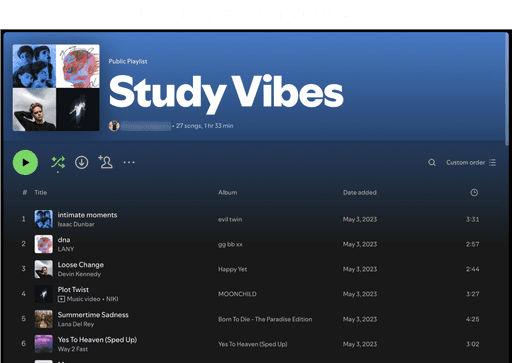
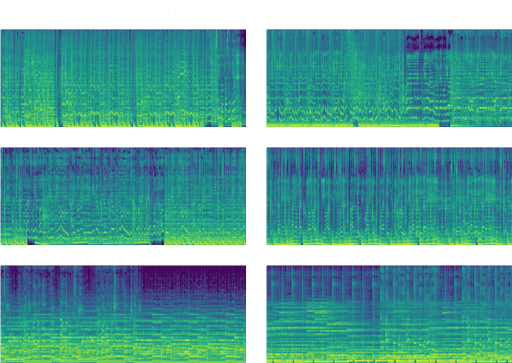
To deliver personalized auditory solutions that enhance focus and improve emotional regulation, a Music Emotion Recognition Model was developed. The model analyzes the user’s playlist, identifying tracks that are emotionally uplifting, aiming to improve the user's mood. By integrating this model, users are provided with music that is specifically curated to boost their mood and support emotional well-being.
AI-Powered Personalized Solutions:
To deliver personalized auditory solutions that enhance focus and improve emotional regulation, a Music Emotion Recognition Model was developed. The model analyzes the user’s playlist, identifying tracks that are emotionally uplifting, aiming to improve the user's mood. By integrating this model, users are provided with music that is specifically curated to boost their mood and support emotional well-being.
AI-Powered Personalized Solutions:
To deliver personalized auditory solutions that enhance focus and improve emotional regulation, a Music Emotion Recognition Model was developed. The model analyzes the user’s playlist, identifying tracks that are emotionally uplifting, aiming to improve the user's mood. By integrating this model, users are provided with music that is specifically curated to boost their mood and support emotional well-being.
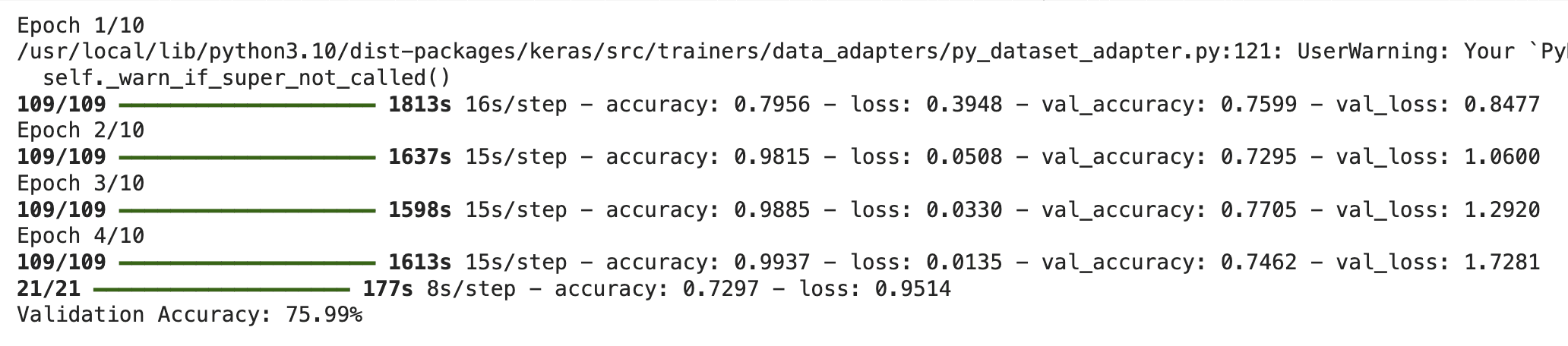
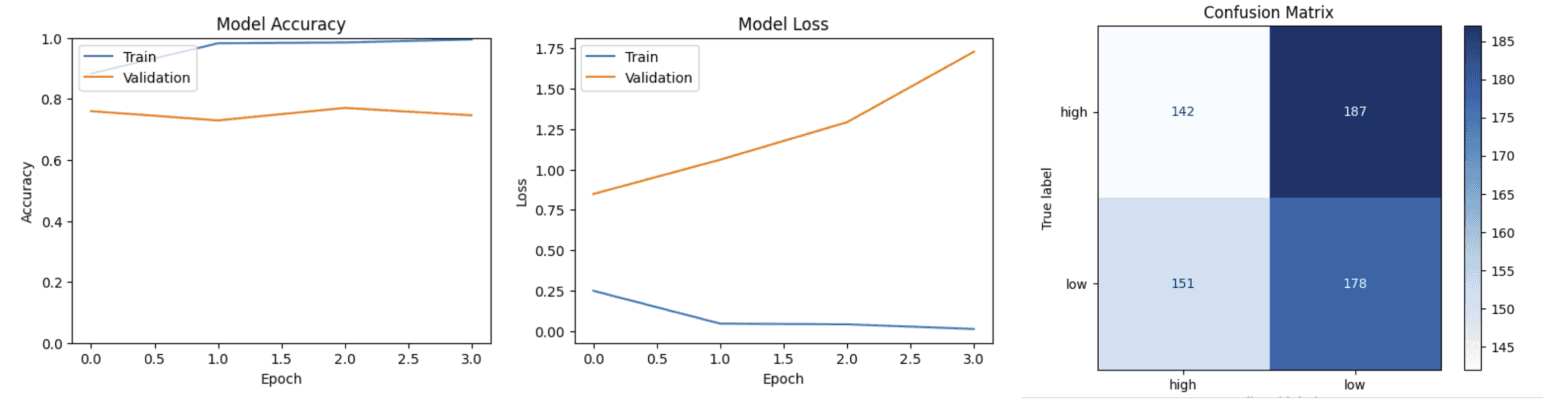
Music Emotion Recognition Model: Training and Validation Performance
Music Emotion Recognition Model: Training and Validation Performance
Integrating Personalized Solutions in the Environment:
To enhance focus, music and lighting were integrated into the user’s environment.
The selected tracks are converted into infinite audio loops, ensuring a continuous auditory environment that minimizes distractions. The looping feature is crucial for maintaining focus, as it provides a rhythmic, repetitive auditory backdrop that aids concentration and reduces the cognitive load caused by task-switching or external distractions. The infinite loops also prevent disruptions that typically occur with traditional music tracks, where silence between songs can break focus.
Integrating Personalized Solutions in the Environment:
To enhance focus, music and lighting were integrated into the user’s environment.
The selected tracks are converted into infinite audio loops, ensuring a continuous auditory environment that minimizes distractions. The looping feature is crucial for maintaining focus, as it provides a rhythmic, repetitive auditory backdrop that aids concentration and reduces the cognitive load caused by task-switching or external distractions. The infinite loops also prevent disruptions that typically occur with traditional music tracks, where silence between songs can break focus.
Integrating Personalized Solutions in the Environment:
To enhance focus, music and lighting were integrated into the user’s environment.
The selected tracks are converted into infinite audio loops, ensuring a continuous auditory environment that minimizes distractions. The looping feature is crucial for maintaining focus, as it provides a rhythmic, repetitive auditory backdrop that aids concentration and reduces the cognitive load caused by task-switching or external distractions. The infinite loops also prevent disruptions that typically occur with traditional music tracks, where silence between songs can break focus.
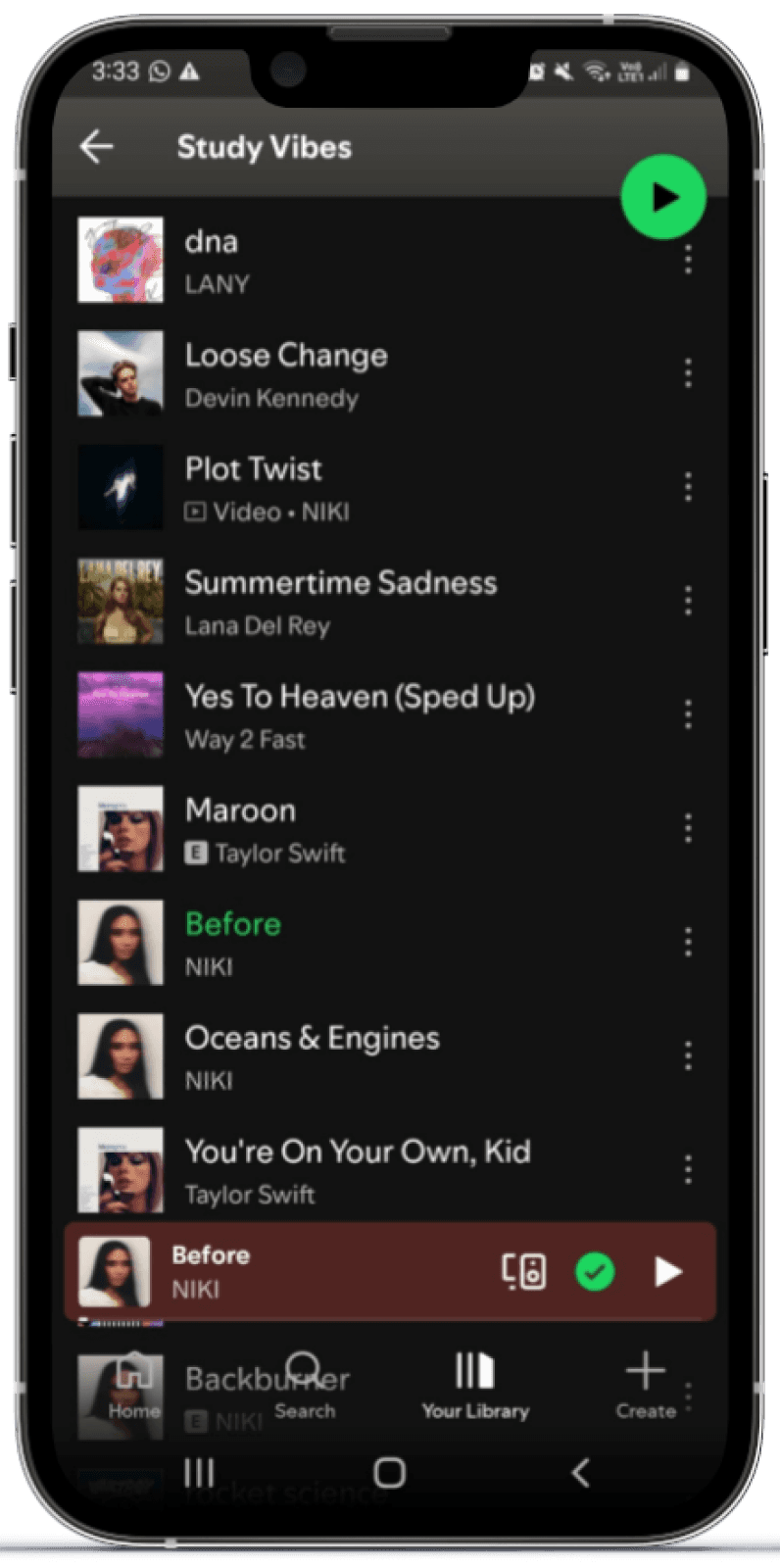
High-arousal track playlist
High-arousal track playlist
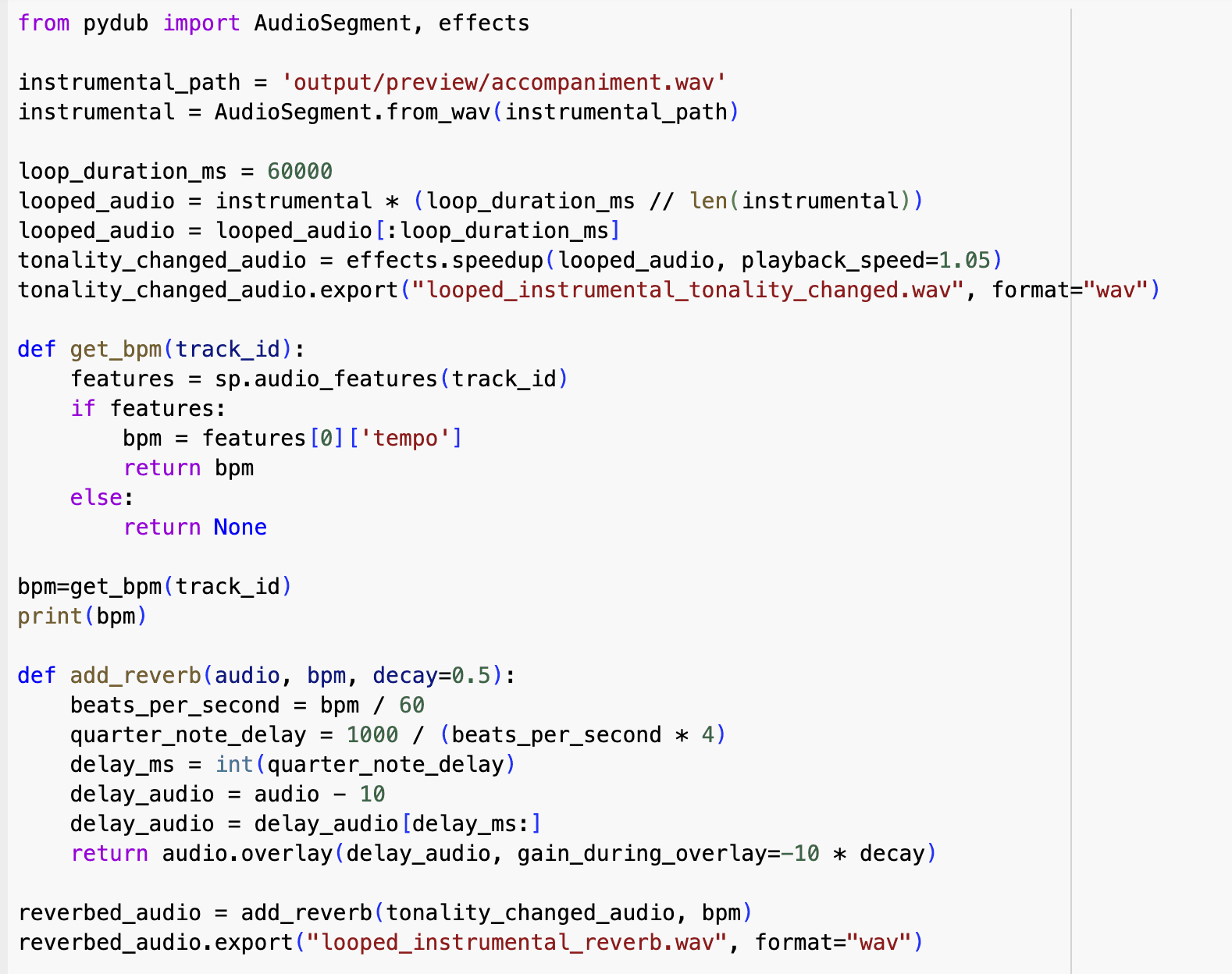
Algorithm to transform a playlist into continuous looped tracks
Algorithm to transform a playlist into continuous looped tracks
Algorithm to transform a playlist into continuous looped tracks
Focused environment enhanced by custom-looped music tracks tailored for concentration and emotional regulation
Focused environment enhanced by custom-looped music tracks tailored for concentration and emotional regulation
Focused environment enhanced by custom-looped music tracks tailored for concentration and emotional regulation
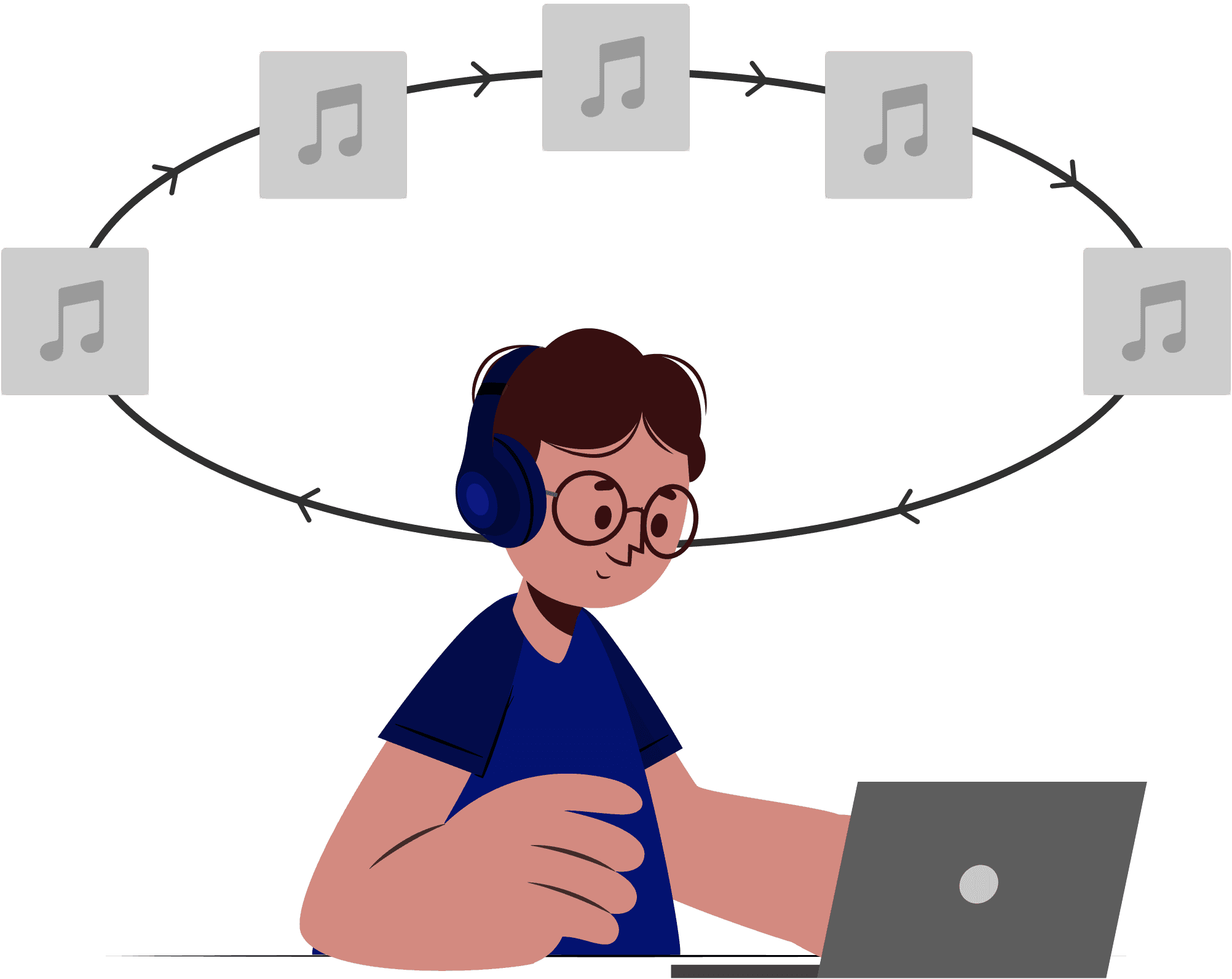
Additionally, the integration of smart lighting allows users to customize the color and intensity of their environment, enhancing their cognitive state. Users can experiment with different lighting settings to find what works best for them, creating a personalized study environment that aligns with their needs.
Light conditions play a crucial role in enhancing focus, comfort, and relaxation:
Study: Cool white light (4000K-6500K) improves focus and alertness
Reading: Blue-infused light (4000K-5000K) reduces eye strain and enhances clarity
Sleep: Red light promotes relaxation and aids sleep by minimizing melatonin disruption
Additionally, the integration of smart lighting allows users to customize the color and intensity of their environment, enhancing their cognitive state. Users can experiment with different lighting settings to find what works best for them, creating a personalized study environment that aligns with their needs.
Light conditions play a crucial role in enhancing focus, comfort, and relaxation:
Study: Cool white light (4000K-6500K) improves focus and alertness
Reading: Blue-infused light (4000K-5000K) reduces eye strain and enhances clarity
Sleep: Red light promotes relaxation and aids sleep by minimizing melatonin disruption
Additionally, the integration of smart lighting allows users to customize the color and intensity of their environment, enhancing their cognitive state. Users can experiment with different lighting settings to find what works best for them, creating a personalized study environment that aligns with their needs.
Light conditions play a crucial role in enhancing focus, comfort, and relaxation:
Study: Cool white light (4000K-6500K) improves focus and alertness
Reading: Blue-infused light (4000K-5000K) reduces eye strain and enhances clarity
Sleep: Red light promotes relaxation and aids sleep by minimizing melatonin disruption
Designing the App
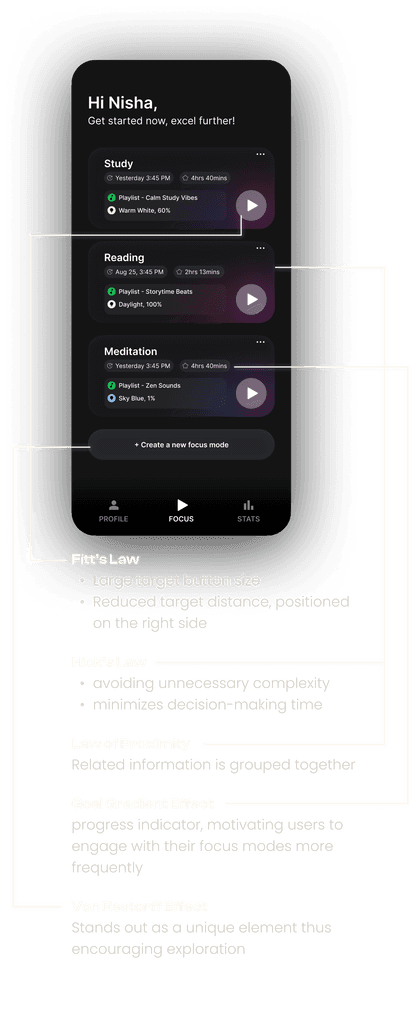
The application was designed to offer the proposed solution in a simple and intuitive manner. The combination of smart lighting control and personalized music loops allows users to create an environment conducive to concentration and emotional regulation. The easy-to-navigate accessible app minimizes distractions and decision fatigue, giving users a seamless way to enhance their environment for better productivity.
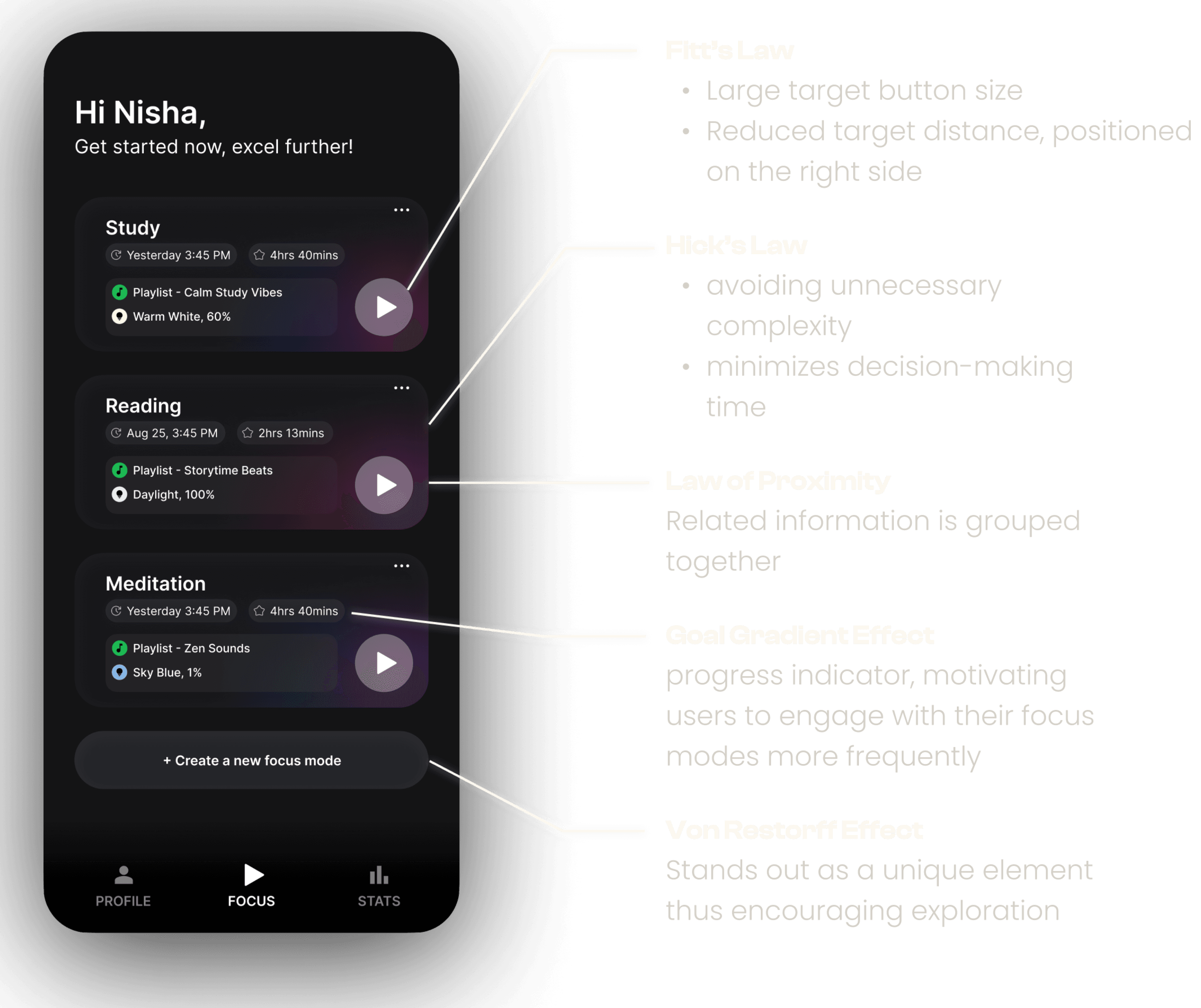
Main Dashboard:
It is designed to minimize distractions and help users stay focused on key actions. It consists of a simple interface with two primary actionable items:
Play the Scene: This button allows users to quickly activate a pre-configured scene, which includes the lighting and music settings they have chosen.
Create a New Task: A clean, easy-to-access option for users to design a new focus environment by selecting music and lighting preferences tailored to their current needs.
This design follows key UX principles to enhance accessibility, including:
Designing the App
The application was designed to offer the proposed solution in a simple and intuitive manner. The combination of smart lighting control and personalized music loops allows users to create an environment conducive to concentration and emotional regulation. The easy-to-navigate accessible app minimizes distractions and decision fatigue, giving users a seamless way to enhance their environment for better productivity.
Main Dashboard:
It is designed to minimize distractions and help users stay focused on key actions. It consists of a simple interface with two primary actionable items:
Play the Scene: This button allows users to quickly activate a pre-configured scene, which includes the lighting and music settings they have chosen.
Create a New Task: A clean, easy-to-access option for users to design a new focus environment by selecting music and lighting preferences tailored to their current needs.
This design follows key UX principles to enhance accessibility, including:
Designing the App
The application was designed to offer the proposed solution in a simple and intuitive manner. The combination of smart lighting control and personalized music loops allows users to create an environment conducive to concentration and emotional regulation. The easy-to-navigate accessible app minimizes distractions and decision fatigue, giving users a seamless way to enhance their environment for better productivity.
Main Dashboard:
It is designed to minimize distractions and help users stay focused on key actions. It consists of a simple interface with two primary actionable items:
Play the Scene: This button allows users to quickly activate a pre-configured scene, which includes the lighting and music settings they have chosen.
Create a New Task: A clean, easy-to-access option for users to design a new focus environment by selecting music and lighting preferences tailored to their current needs.
This design follows key UX principles to enhance accessibility, including:
Setup Screens:
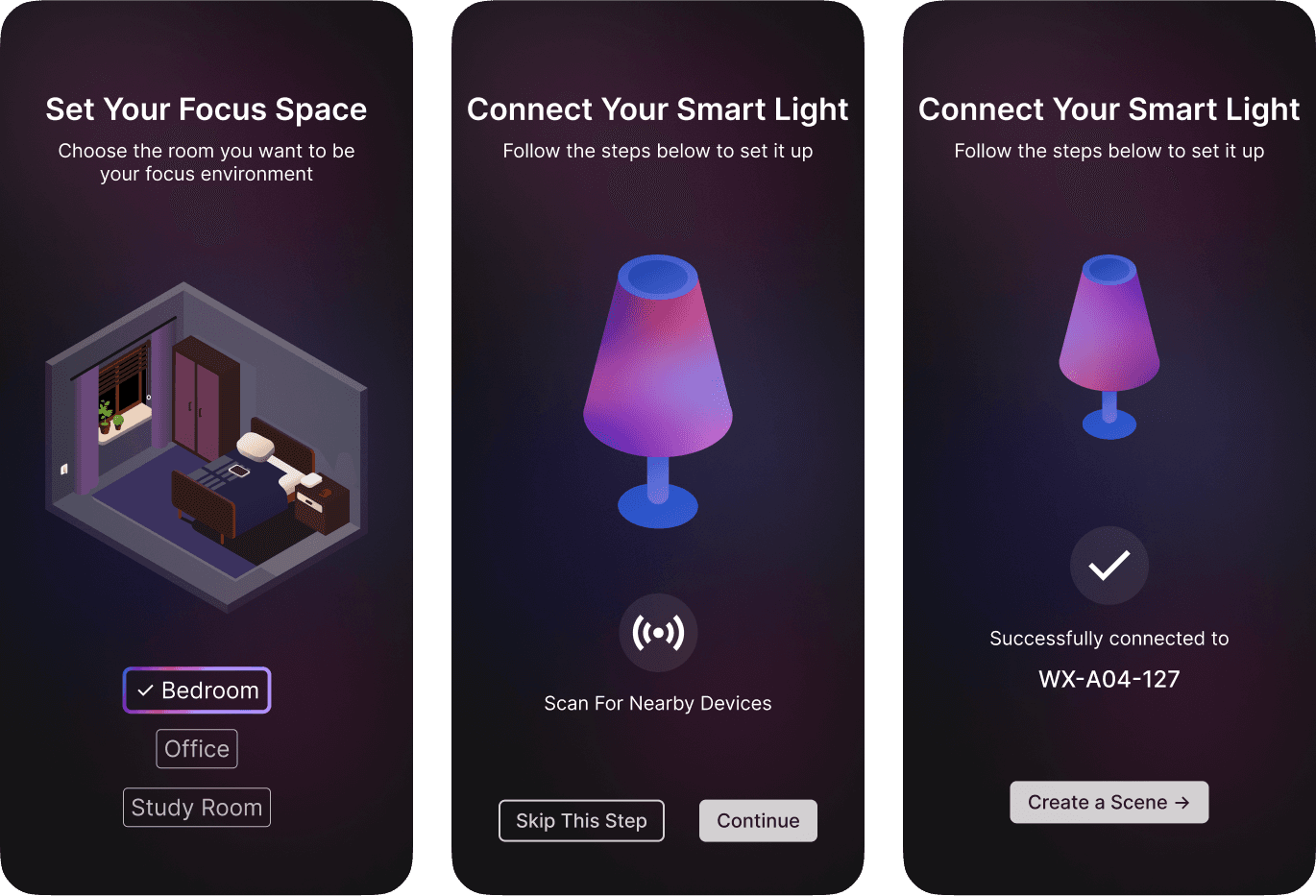
The Light Connection Setup and Room Setup Screens allow users to choose their focus space and then connect their smart lighting devices to the app. It is a one-time setup process, and gives users clear instructions and visual cues ensure they can easily set up their room and lighting conditions.
Setup Screens:
The Light Connection Setup and Room Setup Screens allow users to choose their focus space and then connect their smart lighting devices to the app. It is a one-time setup process, and gives users clear instructions and visual cues ensure they can easily set up their room and lighting conditions.
Setup Screens:
The Light Connection Setup and Room Setup Screens allow users to choose their focus space and then connect their smart lighting devices to the app. It is a one-time setup process, and gives users clear instructions and visual cues ensure they can easily set up their room and lighting conditions.
Create a new scene:
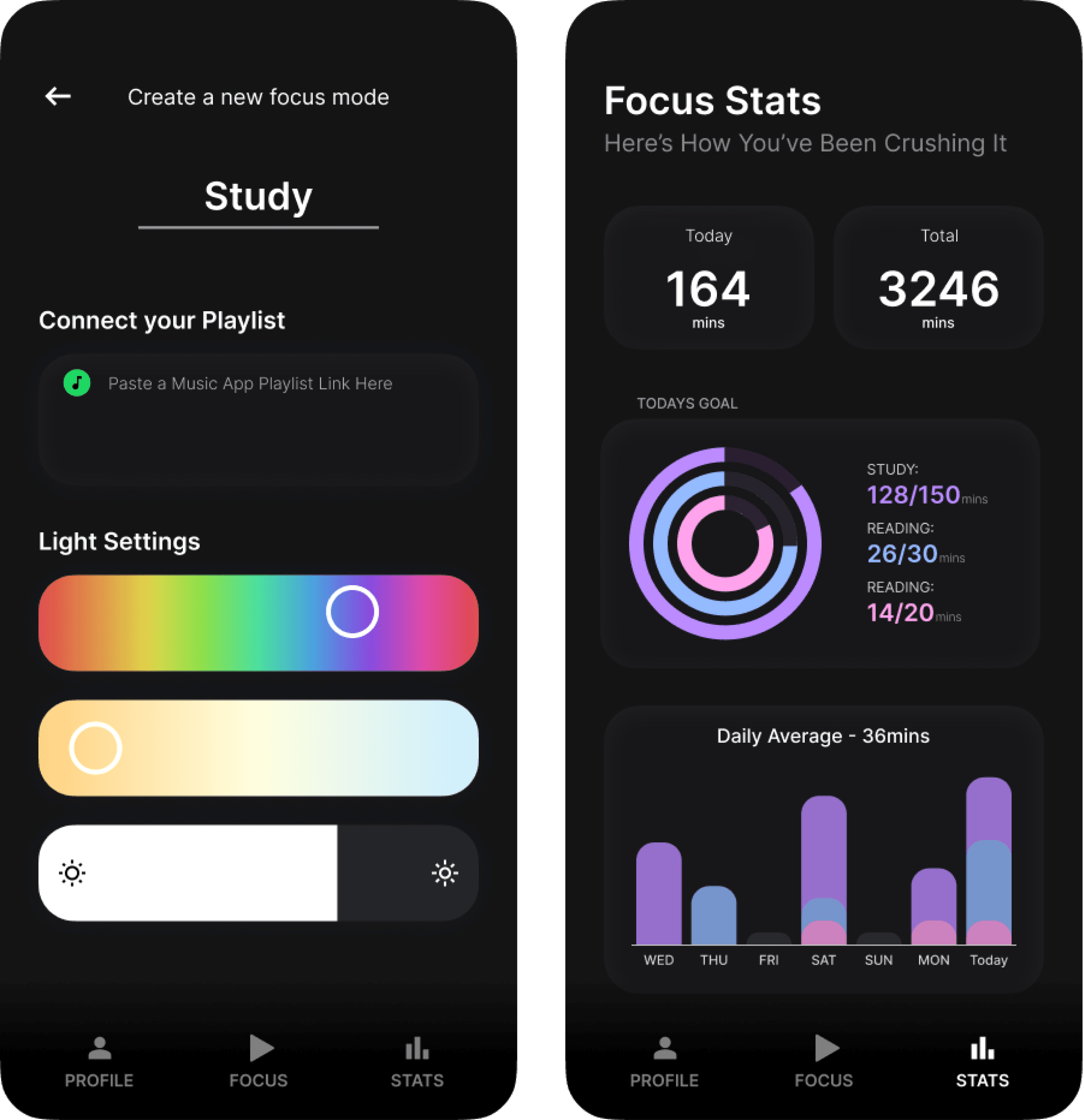
The "Create a New Scene" screen enables users to customize their environment with precision. It features a field to input music playlist links for seamless integration and sliders to adjust light color (warm-to-cool spectrum) and brightness or opacity. Designed with Hick’s Law and Fitts’s Law in mind, it minimizes decision-making while optimizing interaction. High-contrast elements and scalable inputs ensure accessibility, allowing users to quickly create tailored, distraction-free settings.
Create a new scene:
The "Create a New Scene" screen enables users to customize their environment with precision. It features a field to input music playlist links for seamless integration and sliders to adjust light color (warm-to-cool spectrum) and brightness or opacity. Designed with Hick’s Law and Fitts’s Law in mind, it minimizes decision-making while optimizing interaction. High-contrast elements and scalable inputs ensure accessibility, allowing users to quickly create tailored, distraction-free settings.
Create a new scene:
The "Create a New Scene" screen enables users to customize their environment with precision. It features a field to input music playlist links for seamless integration and sliders to adjust light color (warm-to-cool spectrum) and brightness or opacity. Designed with Hick’s Law and Fitts’s Law in mind, it minimizes decision-making while optimizing interaction. High-contrast elements and scalable inputs ensure accessibility, allowing users to quickly create tailored, distraction-free settings.
Create a new scene:
The "Focus Stats" page provides a streamlined and data-driven interface to track user productivity. Key metrics include total focus time for the day and cumulative focus minutes, alongside a goal-tracking visual represented by a progress ring for the top three tasks. A weekly bar graph, color-coded for different tasks, presents time spent across the last seven days, enabling users to analyze performance trends.
Create a new scene:
The "Focus Stats" page provides a streamlined and data-driven interface to track user productivity. Key metrics include total focus time for the day and cumulative focus minutes, alongside a goal-tracking visual represented by a progress ring for the top three tasks. A weekly bar graph, color-coded for different tasks, presents time spent across the last seven days, enabling users to analyze performance trends.
Create a new scene:
The "Focus Stats" page provides a streamlined and data-driven interface to track user productivity. Key metrics include total focus time for the day and cumulative focus minutes, alongside a goal-tracking visual represented by a progress ring for the top three tasks. A weekly bar graph, color-coded for different tasks, presents time spent across the last seven days, enabling users to analyze performance trends.
User Testing
This project proposes a unique conceptual solution aimed at enhancing focus in adults with ADHD by integrating personalized music and lighting. To fully understand its effectiveness and gauge its impact on the target users, real-world testing is crucial.
Due to the conceptual nature of the project, user testing has not yet been carried out. However, efforts are being made to assess the app’s effectiveness in real-world conditions in future stages. Testing will help evaluate how well the app delivers its intended benefits and refine it based on user feedback to ensure its practical application and improvement.
User Testing
This project proposes a unique conceptual solution aimed at enhancing focus in adults with ADHD by integrating personalized music and lighting. To fully understand its effectiveness and gauge its impact on the target users, real-world testing is crucial.
Due to the conceptual nature of the project, user testing has not yet been carried out. However, efforts are being made to assess the app’s effectiveness in real-world conditions in future stages. Testing will help evaluate how well the app delivers its intended benefits and refine it based on user feedback to ensure its practical application and improvement.
User Testing
This project proposes a unique conceptual solution aimed at enhancing focus in adults with ADHD by integrating personalized music and lighting. To fully understand its effectiveness and gauge its impact on the target users, real-world testing is crucial.
Due to the conceptual nature of the project, user testing has not yet been carried out. However, efforts are being made to assess the app’s effectiveness in real-world conditions in future stages. Testing will help evaluate how well the app delivers its intended benefits and refine it based on user feedback to ensure its practical application and improvement.
Conference Presentation & Publication
The paper was presented at ICBTOxford 2024 on November 21st and is set to be published soon in the esteemed Springer LNNS series. The presentation highlighted the innovative solution for enhancing focus in adults with ADHD through customizable music and lighting. This recognition at an academic conference underscores the potential impact of the project. The upcoming publication will contribute to the growing body of research on assistive technologies and sensory interventions.
Conference Presentation & Publication
The paper was presented at ICBTOxford 2024 on November 21st and is set to be published soon in the esteemed Springer LNNS series. The presentation highlighted the innovative solution for enhancing focus in adults with ADHD through customizable music and lighting. This recognition at an academic conference underscores the potential impact of the project. The upcoming publication will contribute to the growing body of research on assistive technologies and sensory interventions.
Conference Presentation & Publication
The paper was presented at ICBTOxford 2024 on November 21st and is set to be published soon in the esteemed Springer LNNS series. The presentation highlighted the innovative solution for enhancing focus in adults with ADHD through customizable music and lighting. This recognition at an academic conference underscores the potential impact of the project. The upcoming publication will contribute to the growing body of research on assistive technologies and sensory interventions.
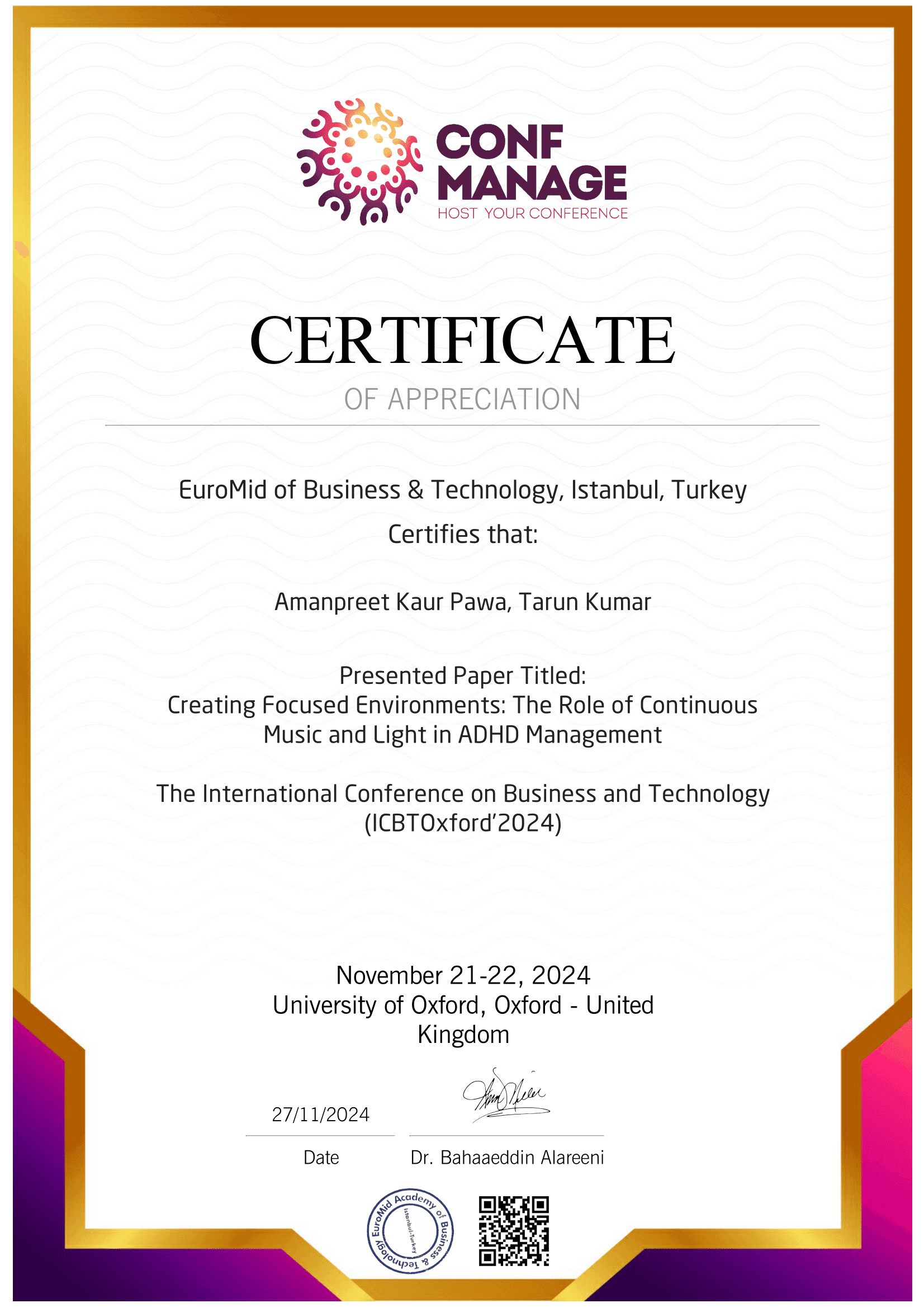
The experience was incredibly rewarding and enlightening, as I gained valuable insights from fellow researchers and professionals in the field. Presenting at such a prestigious conference not only allowed me to showcase the potential of integrating music and lighting into ADHD management but also helped me realize the vast potential for future research and improvements in this space. This presentation reinforced my belief in the power of innovation and collaboration to create practical solutions for individuals with ADHD, and I look forward to continuing my research and development in this area.
The experience was incredibly rewarding and enlightening, as I gained valuable insights from fellow researchers and professionals in the field. Presenting at such a prestigious conference not only allowed me to showcase the potential of integrating music and lighting into ADHD management but also helped me realize the vast potential for future research and improvements in this space. This presentation reinforced my belief in the power of innovation and collaboration to create practical solutions for individuals with ADHD, and I look forward to continuing my research and development in this area.
The experience was incredibly rewarding and enlightening, as I gained valuable insights from fellow researchers and professionals in the field. Presenting at such a prestigious conference not only allowed me to showcase the potential of integrating music and lighting into ADHD management but also helped me realize the vast potential for future research and improvements in this space. This presentation reinforced my belief in the power of innovation and collaboration to create practical solutions for individuals with ADHD, and I look forward to continuing my research and development in this area.
Conclusion
This project presents a conceptual solution to help adults with inattentive ADHD by integrating customizable music and lighting for enhanced focus. The system uses a Music Emotion Recognition model, achieving 75.99% accuracy, to create a personalized, distraction-free environment. The app’s design ensures accessibility and user-friendliness to optimize sustained concentration.
Real-world testing is essential to evaluate the app’s effectiveness and refine it based on user feedback. Future work will focus on testing with ADHD users, expanding the app’s potential to other neurodevelopment conditions, and exploring integration with smart home systems to further enhance its applicability and impact.
Conclusion
This project presents a conceptual solution to help adults with inattentive ADHD by integrating customizable music and lighting for enhanced focus. The system uses a Music Emotion Recognition model, achieving 75.99% accuracy, to create a personalized, distraction-free environment. The app’s design ensures accessibility and user-friendliness to optimize sustained concentration.
Real-world testing is essential to evaluate the app’s effectiveness and refine it based on user feedback. Future work will focus on testing with ADHD users, expanding the app’s potential to other neurodevelopment conditions, and exploring integration with smart home systems to further enhance its applicability and impact.
Conclusion
This project presents a conceptual solution to help adults with inattentive ADHD by integrating customizable music and lighting for enhanced focus. The system uses a Music Emotion Recognition model, achieving 75.99% accuracy, to create a personalized, distraction-free environment. The app’s design ensures accessibility and user-friendliness to optimize sustained concentration.
Real-world testing is essential to evaluate the app’s effectiveness and refine it based on user feedback. Future work will focus on testing with ADHD users, expanding the app’s potential to other neurodevelopment conditions, and exploring integration with smart home systems to further enhance its applicability and impact.